Laser Cataract Surgery vs. Traditional Phaco (2026)
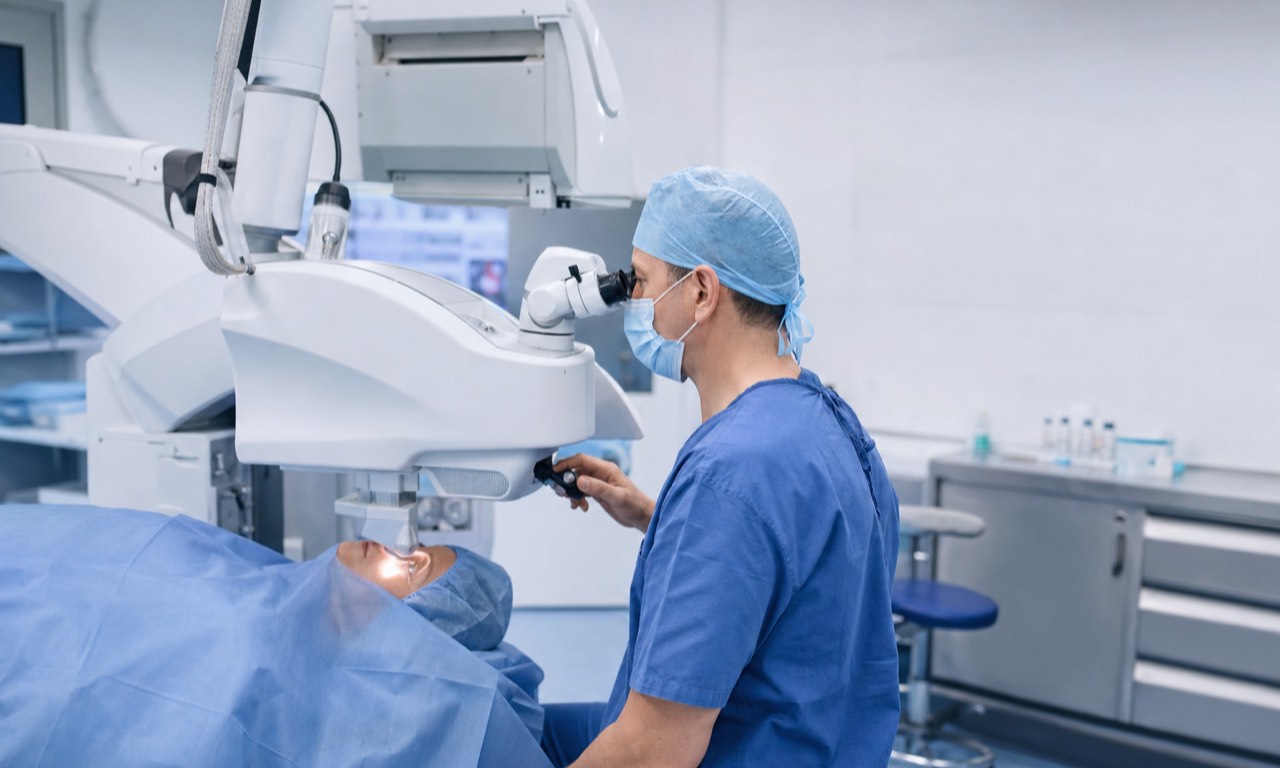
The single most important thing to know is that the laser does not remove the cataract. A femtosecond laser automates three of the manual steps in front of the cataract: the corneal incision, the opening in the lens capsule, and the softening of the lens. The cataract itself still comes out by phacoemulsification, and the intraocular lens is still placed by the surgeon's hand. Patients who benefit most from the laser are those choosing a premium lens with a tight refractive target, those with significant corneal astigmatism, and those with a dense or otherwise demanding cataract. In routine cases, laser-assisted and traditional surgery produce comparable visual outcomes in the published evidence (Cochrane). The laser portion, when used for the glasses-reducing part of surgery, is a patient-pay surcharge that typically runs a few hundred to about $1,500 per eye depending on the practice and region. This guide explains exactly what the laser changes, what it does not, where the evidence lands in 2026, and when we recommend each approach.
What does "traditional" cataract surgery actually involve?
Modern manual cataract surgery, the standard that laser surgery is compared against, is itself a refined, small-incision microsurgery. Calling it "traditional" can make it sound dated. It is not. It is the most commonly performed and most studied version of the operation, and it is the benchmark in the American Academy of Ophthalmology's Cataract in the Adult Eye Preferred Practice Pattern (AAO PPP).
A routine phacoemulsification case has a few defined steps:
- Topical anesthesia. Numbing drops, usually without a needle or general anesthesia, with light sedation for comfort.
- Manual clear-corneal incision. The surgeon makes a small, self-sealing incision at the edge of the cornea, typically around 2 to 3 mm, with a calibrated blade.
- Manual continuous curvilinear capsulorhexis (CCC). The surgeon tears a smooth, round opening in the front of the lens capsule by hand, using fine forceps. The quality and centration of this opening matter for how the IOL sits.
- Phacoemulsification. An ultrasonic probe enters through the incision, breaks the cataract into fragments, and aspirates them. The energy delivered is measured as cumulative dissipated energy, or CDE.
- IOL insertion. The folded intraocular lens is injected into the now-empty capsular bag, where it unfolds and centers.
Each of those steps, when done well, is reliable and reproducible. The laser does not replace this operation. It automates three of the steps that precede lens removal.
What does the femtosecond laser change?
Femtosecond laser-assisted cataract surgery, abbreviated FLACS, uses a laser that fires ultrashort pulses to make precise cuts inside the eye before the surgeon begins phacoemulsification. The platforms in common use include the Alcon LenSx, the Johnson and Johnson Catalys, the Bausch and Lomb Victus, and the Ziemer LDV Z8. Imaging built into the laser, usually optical coherence tomography, maps the eye so the cuts are placed by computer guidance.
The laser automates three steps and can add a fourth:
- The corneal incision. Computer-guided, with a planned length, depth, and architecture, rather than a freehand blade.
- The capsulotomy. The opening in the front of the capsule is made by the laser in a precise circle, which tends to be more consistently round and centered than a manual tear.
- Lens fragmentation. The laser pre-softens and divides the cataract, which can reduce the ultrasound energy (CDE) the surgeon then needs to remove it.
- Optional limbal relaxing incisions (LRIs). The laser can place precise arcuate incisions in the cornea to reduce astigmatism, an optional refractive step.
That precision is the case for the laser. It is real, and it matters more in some eyes than others. To see how this fits our broader surgical approach, review our overview of laser cataract surgery and advanced cataract surgery.
What does the laser NOT change?
This is where marketing and reality diverge, so we will be exact. You will hear laser cataract surgery called "bladeless." It is true that the laser, not a blade, makes the incision, but the phacoemulsification needle still enters the eye to remove the cataract. The laser does not make the operation needle-free, and it does not remove the cataract.
- The cataract is still removed by phacoemulsification. The laser softens and divides the lens; the ultrasonic probe still aspirates it.
- IOL placement is still manual. The surgeon still injects and positions the intraocular lens by hand.
- The IOL power calculation is unchanged. Your lens power comes from the same biometry and formulas whether or not a laser is used. The laser does not make your lens choice more accurate by itself.
- The recovery timeline is the same. Healing, drop schedule, and the pace of visual recovery are essentially identical. See our day-by-day cataract surgery recovery guide.
What does the outcomes evidence show in 2026?
The honest summary is that for routine cataracts, the laser and manual phacoemulsification deliver similar final vision. A Cochrane systematic review comparing FLACS with standard phacoemulsification found little to no meaningful difference in uncorrected or best-corrected visual acuity in routine cases (Cochrane Review CD010735). Comparative series in the Journal of Cataract and Refractive Surgery have reached compatible conclusions.
Where the laser does show measurable differences:
- A more circular, more reproducible capsulotomy. The laser opening is more consistently round and centered than a manual tear, which can support stable IOL positioning.
- Lower phacoemulsification energy. Because the laser pre-fragments the lens, less cumulative dissipated energy is often needed, which may be gentler on the cornea in dense cataracts.
- Improved predictability of astigmatism correction. Laser-placed arcuate incisions are more precise than freehand relaxing incisions, which helps when the goal is a tight refractive target.
What the evidence does not support is the claim that the laser produces better vision for everyone. It does not. The benefits are specific, and they concentrate in particular eyes and particular goals. For background on how this and related conditions fit together, see the AAO EyeWiki entry on femtosecond laser-assisted cataract surgery.
"I do not sell the laser as a better operation. I offer it as a more precise tool for the cases that reward precision: a premium lens with a narrow refractive margin, a cornea with real astigmatism, a rock-hard cataract. For a straightforward eye getting a monofocal, manual phaco is every bit as good, and I will tell you so." Brent Bellotte, MD
When do we recommend laser-assisted cataract surgery?
We recommend the femtosecond laser when its specific strengths line up with your eye and your goals. The clearest indications are:
- A premium IOL with a tight refractive target. When you choose a trifocal or extended depth of focus lens, hitting the refractive target precisely matters more, and the laser's consistent capsulotomy and centration help. See our comparison of PanOptix, Vivity, and Symfony OptiBlue.
- Significant corneal astigmatism. Laser arcuate incisions, or precise alignment for a toric lens, can improve the astigmatic result. See our explainer on correcting astigmatism during cataract surgery.
- A dense, brunescent cataract. Pre-fragmentation can reduce the ultrasound energy needed, which may be gentler on a fragile cornea.
- A compromised cornea, such as Fuchs' dystrophy. Lower phaco energy can be protective for an endothelium that is already vulnerable. See our guide to Fuchs' dystrophy and cataract surgery.
- Zonular weakness. A precise, low-stress capsulotomy can be valuable when the structures supporting the lens are loose.
When is traditional phaco the right call?
For a large share of cataract patients, manual phacoemulsification is the right and equal choice, and recommending the laser surcharge would not serve them. We favor traditional phaco when:
- The case is routine and the plan is a monofocal lens. With no premium lens and no astigmatism target, the laser adds cost without a meaningful outcome benefit.
- Cost matters to you. The laser is a patient-pay add-on. If a monofocal result is your goal, manual phaco delivers it without that fee.
- The pupil dilates poorly. A small pupil can limit the laser's access and reliability, and an experienced surgeon may achieve a better result manually.
- You cannot lie flat or hold still for the docking step. The laser requires the eye to be docked to the device, which not every patient tolerates.
- There is severe corneal scarring or opacity. The laser's imaging needs a clear optical path; dense scarring can degrade its guidance.
What does it cost in 2026?
Medicare Part B covers your cataract surgery and a standard intraocular lens. After your annual Part B deductible, Medicare pays 80% of the approved amount and you pay 20% coinsurance, per the Centers for Medicare and Medicaid Services (medicare.gov).
Medicare does not cover the femtosecond laser surcharge when the laser is used for the refractive, glasses-reducing portion of the procedure. That laser fee is a patient-pay cost, typically a few hundred dollars to about $1,500 per eye depending on the practice and region, and it is often bundled with a premium IOL or astigmatism-correction package. If you are also choosing a premium lens, that is a separate patient-pay cost on top of the laser fee; we break that down in our guide to Medicare premium IOL coverage. We give you the exact figures for your plan in writing before you decide.
What does recovery look like?
Recovery is the same whether or not a laser is used, because the healing happens around the same small incision and the same implanted lens. Most patients see noticeably better within a day or two, use anti-inflammatory and antibiotic drops on a tapering schedule, and avoid rubbing the eye and heavy lifting for a short period. Vision continues to sharpen over the first few weeks as the eye settles and any swelling resolves. For the full timeline, see our day-by-day recovery guide.
How we decide with you
The laser-versus-manual decision is downstream of two bigger questions: which lens fits your eyes, and what refractive result you are aiming for. Once those are settled, whether to add the femtosecond laser is usually clear. We measure your cornea, assess your cataract density, review your astigmatism, and tell you plainly whether the laser would add value in your case or simply add cost.
A subspecialty cataract practice will answer that for your specific eye rather than apply one policy to everyone. You can read our overview of laser cataract surgery and advanced cataract surgery, and when you are ready, schedule a cataract evaluation. This article was prepared by the surgical team at Modern Cataract Surgery, including Brent Bellotte, MD.
Frequently Asked Questions
Does the laser remove the cataract?
No. The femtosecond laser automates the corneal incision, the opening in the lens capsule, and the softening of the cataract. The cataract itself is still removed by phacoemulsification, with an ultrasonic probe, and the intraocular lens is still placed by the surgeon's hand. The laser prepares the steps in front of the removal.
Is laser cataract surgery safer than traditional?
In routine cases the two approaches have similar safety and similar visual outcomes in the published evidence. The laser can create a more consistent capsulotomy and lower ultrasound energy, which may help in specific eyes. It is not categorically safer for every patient, and both are very safe procedures in experienced hands.
Will I see better with laser cataract surgery?
For most routine cases, final corrected vision is comparable between laser-assisted and traditional surgery. The laser's advantage is precision in certain steps, which can matter when you choose a premium lens with a tight refractive target or have significant astigmatism. Your lens choice usually affects your glasses freedom more than laser versus manual does.
Does Medicare cover the laser portion of cataract surgery?
Medicare covers the cataract surgery and a standard intraocular lens. It does not cover the femtosecond laser surcharge when the laser is used for the refractive, glasses-reducing portion of the procedure. That laser fee is a patient-pay cost, typically a few hundred to about $1,500 per eye depending on the practice and region.
Can I get the laser with a standard monofocal lens?
Sometimes, but it is less common. The femtosecond laser is most often paired with a premium lens or with astigmatism correction, where its precision adds the most value. With a routine monofocal and no astigmatism plan, traditional phacoemulsification typically delivers an equivalent result without the added laser cost.
How much time does the laser add to surgery?
The laser step adds only a few minutes. It is performed first, often in a separate suite, then you move to the operating area for phacoemulsification and lens implantation. Total time in the surgical center is modestly longer, but the actual operation remains brief and is still done under topical anesthesia in most cases.
References
- American Academy of Ophthalmology. Cataract in the Adult Eye Preferred Practice Pattern. aao.org.
- Day AC, Gore DM, Bunce C, Evans JR. Laser-assisted cataract surgery versus standard ultrasound phacoemulsification cataract surgery. Cochrane Database of Systematic Reviews. cochrane.org.
- American Academy of Ophthalmology EyeWiki. Femtosecond Laser-Assisted Cataract Surgery. eyewiki.aao.org.
- Journal of Cataract & Refractive Surgery. Comparative outcomes of femtosecond laser-assisted and conventional phacoemulsification.
- Centers for Medicare & Medicaid Services. Cataract surgery coverage. medicare.gov.
Choosing the right surgeon matters more than choosing the right technology. Compare top-rated cataract surgeons by patient reviews and experience, or search for a cataract surgeon near you.
This article is general information about cataract surgery, not medical advice, and it is not a substitute for consultation with a qualified ophthalmologist. Read our medical disclaimer.
Choosing a Cataract Surgeon?
Compare 303 top cataract surgeons with real patient reviews, ratings, and locations.
Browse the directory · Search by ZIP · Read the national guide
Latest Articles
Cataract Surgery with Glaucoma: How Combined MIGS Procedures Work in 2026

Cataract Surgery with Macular Degeneration: Will It Help Your Vision?
Endophthalmitis After Cataract Surgery: Warning Signs, Incidence, and Modern Prevention